
How to Get Rid of Mildew Smell: Step-by-Step Fixes

You cleaned the carpet on Saturday, lit a candle, and it smelled fine. By Tuesday, that sour, damp towel smell is back when you walk in the door. That's the classic loop that keeps repeating, and it usually isn't a cleaning problem. It's a ** moisture problem ** hiding under, inside, or behind what you cleaned. If you want to get rid of mildew smell for good, you have to find the water, beat the drying clock, and only then clean and deodorize.
Find Where the Smell Starts Before You Clean
Practical rule: A mildew smell is a moisture symptom, so cleaning alone rarely ends it.
Put the scrub brush down for ten minutes. The EPA guidance on ten things to know about mold states that mold can grow on virtually any substance when moisture is present, that there's no practical way to eliminate all mold spores indoors, and that controlling indoor mold requires controlling moisture. It also advises cleaning promptly and correcting the water problem, because cleaning without fixing the source will most likely allow the problem to return.
Match the Room to the Check
| Location | Most likely cause | First check |
|---|---|---|
| Carpet and area rug | Wet pad or subfloor, pet urine under the carpet | Lift the edge and press the pad near the wall for dampness or sour smell |
| Upholstered sofa or chair | Spills or sweat soaked into the foam core | Lift a cushion and smell the foam and the underside of the fabric |
| Closet | High humidity, cold exterior wall, packed clothing | Place a hygrometer inside and look for dark spots on the back wall |
| Tile grout and shower | Standing water, weak exhaust fan, cracked caulk | Check for dark grout lines and time the fan after a shower |
| HVAC vents | Condensation in the drain pan, dirty coil or ductwork | Run the system and note whether the smell is strongest in the first minutes |
Walk the rows in order. Press hard on carpet pad near an exterior wall or under a plant. A cool, damp, sour foam feel tells you the top fibers aren't the main issue. On a sofa, your nose close to the foam core tells you more than sniffing the armrest. In a closet, a cheap hygrometer on the back shelf plus dark spotting on a cold exterior wall points to condensation, not dirty clothes. If the odor only hits when air starts moving, study the mold prevention tips from Covenant Aire Solutions before you blame the nearest vent cover.
Follow this order every time: find the water, dry, clean, then deodorize. If you can't find the source, or the smell is strongest at a wall base or floor seam, stop and bring in a professional. Pick the row that matches your home and jump to that procedure below.
Dry Within 48 Hours and Keep Humidity in Check
Press your palm into a carpet that got soaked yesterday. The fibers may feel dry while the pad underneath still holds water, and that hidden moisture is what keeps the mildew smell alive. Drying gets its own clock, separate from the cleaning.
The EPA brief guide to mold, moisture, and your home advises drying wet or damp materials and areas within 24 to 48 hours after a leak, spill, or other water event, and notes that materials dried within that window generally avoid mold growth. The EPA also recommends keeping indoor relative humidity between 30% and 60%, which is worth checking with a cheap hygrometer rather than trusting how the air feels. Absorbent furnishings make both targets harder to hit because carpet, rugs, and upholstery can feel finished on top while the pad or cushion core stays wet underneath.
Drying Targets by Material
| Material | Drying target | Main method |
|---|---|---|
| Carpet and pad | Within 24 to 48 hours of the wet event | Extract, lift an edge, aim fans across the surface, dehumidify |
| Upholstered cushions | Within 24 to 48 hours | Remove cushions, stand them on edge, fan the core |
| Area rug | Within 24 to 48 hours, flipped to dry both sides | Take outdoors if possible, dry on a clean rack, fan the floor beneath |
| Closet and wall cavity | Interior air below 60% relative humidity | Open the door, add a dehumidifier, check the back wall |
| Whole room air | Relative humidity between 30% and 60% | Hygrometer reading, exhaust fan, dehumidifier as needed |
I would start with airflow you already own. Pull a wet carpet edge back a few inches so the pad can breathe. Aim box fans across the surface so damp air keeps moving away; a fan pointed straight down just presses moist air back into the fibers. Stand cushions on their edges like books, and leave closet doors open a few inches until the hygrometer settles down. A dehumidifier running in the same room shortens the job because the fans then have drier air to push through the material. If a room stays muggy even with fans running, Heatwave's guide to reducing indoor humidity is a useful walkthrough for sizing your approach to the space instead of guessing.
Keep It Dry Afterward
- Run the exhaust fan longer: Leave it on during a shower and for about 20 minutes after.
- Wipe condensation: Dry window sills and cold pipes instead of letting water sit.
- Give walls breathing room: Keep furniture 2 to 3 inches off exterior walls.
- Never store damp laundry: A closed hamper of wet towels restarts the whole cycle.
Say a basement carpet still feels cool and damp on day three. Peel back a corner and press the pad. Spongy or sour means the pad needs replacing, and another round of surface cleaner will only delay the smell returning. If odor comes back after thorough drying, suspect hidden moisture in the pad, subfloor, or wall cavity and investigate there before you deodorize again.
Safe Cleaners, Eco Options and What to Avoid
Choose the mildest cleaner that matches the surface, and make drying part of the job before the first application. A scented spray may cover mildew odor for an afternoon while damp material keeps producing it. For households with kids, pets, asthma, or chemical sensitivities, start with plain products, ventilation, and protective equipment. The CDC mold health guidance recommends detergent and water for hard surfaces, immediate drying, ventilation during cleaning, and protective equipment. It also notes that porous material that cannot be cleaned and dried may need to be discarded and that bleach is not generally recommended for routine mold removal on porous materials.
Compare Before You Pour
| Cleaner | Best use | Avoid when |
|---|---|---|
| Mild detergent in warm water | Tile and other washable hard surfaces, closet shelves, light surface mildew | Soft material that cannot be rinsed well, since residue can attract soil |
| White vinegar diluted 1:1 with water | Hard surfaces, closet walls, light odor | Natural stone and some grout |
| 3% hydrogen peroxide | Light stains on tile and grout, fabric after a colorfastness check | Colored fabrics that may bleach |
| Baking soda | Absorbing odor in cushions, rugs and closets | Used alone as a cleaner, since it does not remove growth |
| Enzyme cleaner | Organic residue such as pet urine in carpet or upholstery | Materials the label does not list as safe |
| Diluted bleach | Non-porous hard surfaces only | Porous materials, and any mixture with ammonia, vinegar, or another cleaner |
Eco options work within clear limits. Vinegar suits washable hard surfaces and light odor, baking soda absorbs odor without removing growth, and enzyme cleaners address organic residue such as pet urine. If grout is the main target, this guide to an eco-friendly grout cleaner approach helps match the product to the surface. A plant-friendly product still has a drying limit, and it cannot save a soaked cushion that never dries.
- Respect the fabric test: A hidden-corner colorfastness check is the gate for carpet, rugs, and upholstery. Dye transfer rules that product out.
- Follow label dilution: More concentrate than the label allows will not fix a moisture source, and it can damage fibers.
- Ventilate while you work: Open a window or run a fan, and wear gloves.
How to Clean Carpets, Rugs and Upholstery
Soft surfaces hold the smell longest because they hold water longest. Work slowly enough to extract well, and don't soak a piece you can't dry.
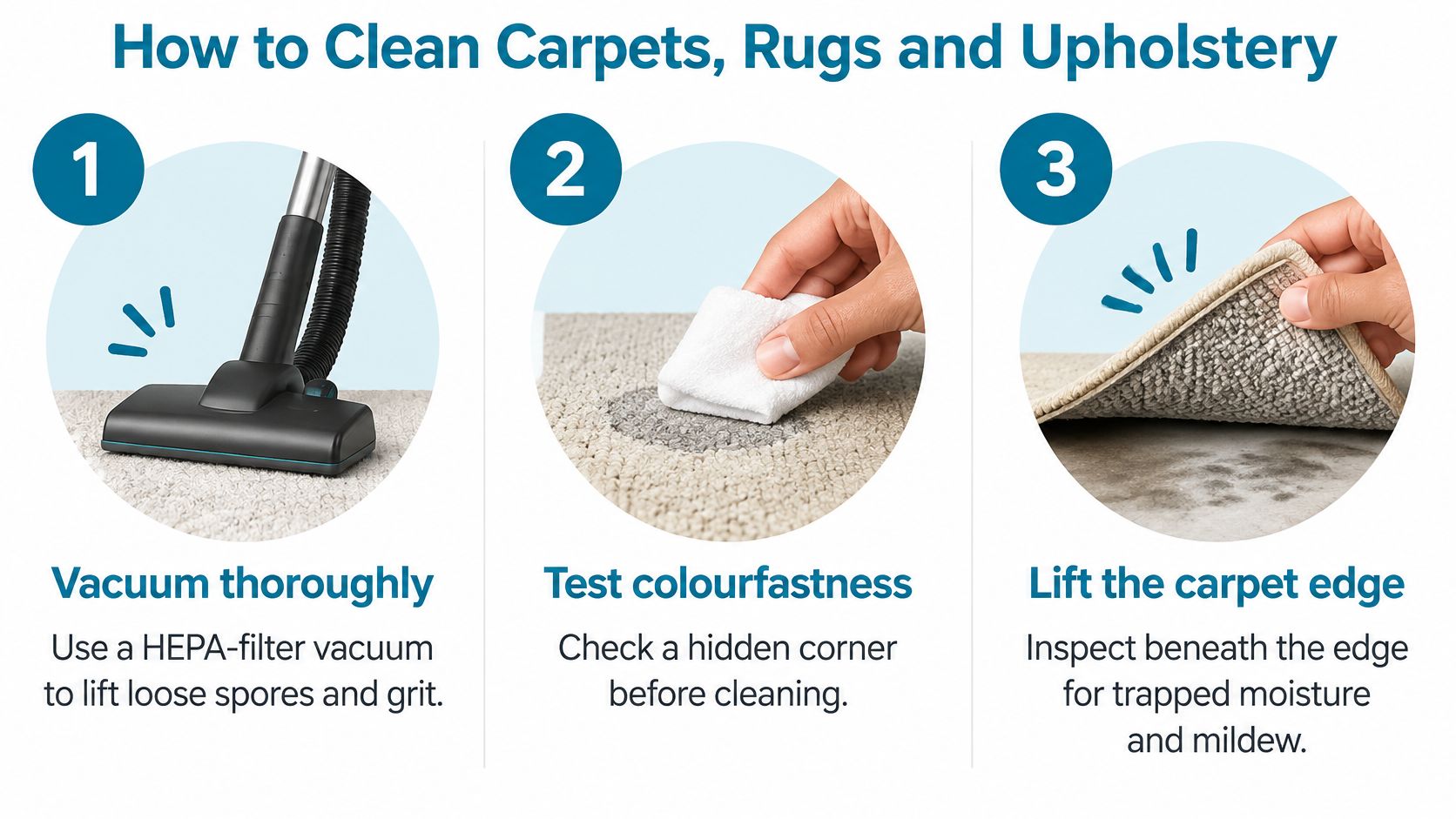
Carpet Steps That Remove the Source
- Vacuum thoroughly: Use a vacuum with a HEPA filter and make slow passes. You're lifting loose spores and grit so your cleaning solution reaches the fibers instead of turning dirt into mud.
- Test colorfastness: Dab your solution in a hidden corner under furniture. Wait, blot with a white towel, and check for color transfer before you commit to the whole area.
- Check the pad: Lift the carpet edge near the smell. If the pad is soaked, crumbles, or smells sour when you press it, plan to replace that section. Cleaning good carpet over bad pad wastes your afternoon.
- Pre-treat and let it dwell: Apply an enzyme cleaner for pet urine and other organic residue, or a few drops of dish soap diluted in warm water for general soil. Let it sit 10 to 15 minutes so it can break down residue, but don't let it dry in place.
- Extract or rinse: Use a rented extractor with clean, hot water and make more dry passes than wet passes. If you're working by hand, rinse with small amounts of clean water and blot hard with towels. Leaving soapy residue behind attracts soil and gives odor something to feed on. For odor that survives a first pass because moisture sat too long, the carpet deodorizing tips from RestoTek TX explain why repeated extraction and drying beat stronger scented products.
- Dry with fans running: Keep air moving for a full day or two, with furniture blocked up or moved off the area. Don't put a rug, storage bin, or sofa leg back on damp carpet.
- Recheck when fully dry: Get your nose down at floor level once the surface and pad feel dry. Wet carpet smells different from finished carpet, and judging too early sends people into unnecessary extra treatments.
Area Rugs Need Both Sides Dried
Rugs fail on the back. Clean the face, flip the rug, and clean or rinse the back lightly, since the backing and any rug pad trap moisture against the floor. Then drape it over a clean rack or rail so moving air reaches both sides at once. A rug dried flat on one face can smell fine on top and still carry sour odor underneath, which is why people think the smell "came back" when it never left.
A 6-by-9 foot wool rug in a damp bedroom is the slowest case I'd plan around. Expect two days of drying and a second, lighter pass on the pad side. Wool holds water, hates harsh chemistry, and can bleed color, so patience and a patch test matter more than scrubbing harder.
Upholstery Without Soaking the Core
Find the care code tag under a cushion first. W means water-based cleaning, S means solvent only, WS allows either, and X means vacuum only. Ignoring that tag is how a washable-looking chair ends up water-stained.
Vacuum with an upholstery tool, including seams and under cushions. Spot clean with foam from a diluted soap solution rather than pouring liquid onto the fabric. Work a small area, blot, and move on. If odor lives deeper than the cover, this guide to furniture odor removal covers how to treat the piece without driving moisture into the frame. Then stand cushions on edge in front of a fan until the core no longer feels cool to the touch.
A rental machine is fine for a fresh spill in one room. A professional truck-mounted extraction earns its cost when odor covers a whole room, pet urine has reached the pad, or a rental pass leaves the carpet wetter than you started. Stronger suction leaves less water behind, which shortens your drying window.
If the top of the carpet smells clean but the pad still smells sour, you haven't finished. You've only cleaned the lid.
How to Clean Tile Grout and Closets
Grout and closets look unrelated, but both fail the same way. Water gets in, air doesn't, and the smell settles.

Scrub Grout and Test the Seal
- Mix a simple paste: Combine baking soda with a little water, or put a squirt of dish soap in warm water. You don't need a harsh product to lift surface soil from grout lines.
- Scrub and wait: Work a stiff brush along each line, then let the solution sit 5 to 10 minutes. Short strokes with pressure beat long, fast swipes that just spread dirty water around.
- Rinse clean: Wipe and rinse with clean water until the towel stops picking up gray residue. Dirty rinse water left in the line dries right back into the grout.
- Dry it on purpose: Towel the surface, then run a fan across the floor for about an hour. A shower floor that's still wet at bedtime is tomorrow's odor.
- Test whether grout needs resealing: Drip water on a dry grout line. If it soaks in within a few seconds and darkens, the grout is drinking water and needs resealing after it dries fully.
Check corner caulk while you're there. If dark staining shows under the caulk surface, scrubbing won't reach it. Cut the caulk out, let the joint dry, and replace it rather than layering new caulk over contaminated material.
Empty the Closet Before You Clean It
- Empty and vacuum: Pull everything out, then vacuum shelves, corners, and the floor. Packed clothing blocks both your view and your airflow.
- Wipe surfaces: Use a diluted vinegar solution on painted shelves and walls, and skip bleach in this small, enclosed space. Wring the cloth well so you're not adding moisture.
- Deal with the contents separately: Wash or air out any fabric items that smell before they go back in. Clean shelves plus sour sweaters equals a sour closet again by Friday.
- Dry with the door open: Leave the closet open until walls and shelves feel fully dry to the touch. Closing the door early traps exactly what you just removed.
- Add a moisture buffer: Place a moisture absorber or activated charcoal pack inside, and check it on a schedule instead of forgetting it for a year.
Say a 2-by-4 foot linen closet on an exterior wall smells sour every spring. Moving shelving a couple of inches off that cold wall and adding a small dehumidifier nearby can end the pattern, because the problem was condensation, not dirty towels.
Here's how you tell the difference. A surface cleaning job smells better and stays better once dry. A moisture problem returns in the same spot, darkens the same grout line, or shows up on the same cold wall. That repeat location is your contractor clue, not a reason to scrub harder.
Clear Vents and Neutralize Stubborn Air Odors
A basement vent can smell fine all afternoon, then push out a sour blast on a cold morning the moment the heat kicks on. Scrubbing the vent cover won't fix that. Startup timing points to the drain pan, condensate line, or coil, where water and slime sit until airflow carries the odor into the room.
Check the System in a Safe Order
- Turn everything off: Switch the system off at the thermostat and at the breaker. Never reach near a fan or pan with power live.
- Inspect the drain pan and line: Look for standing water or slime in the pan under the indoor unit. A pan full of sludge explains why the first minutes of run time smell worst.
- Replace the filter: Note the size and rating printed on the frame so the replacement matches. A clogged, damp-smelling filter keeps recycling odor you've already removed elsewhere.
- Wipe what you can reach: Wash vent covers and wipe the first few inches inside the duct opening with a mild soap solution on a well-wrung cloth. That handles dust at the opening; deeper duct work is a different job. If you're deciding how far a homeowner wipe-down should go, this walkthrough on cleaning air vents in a house draws that line clearly.
- Restart and sniff at 15 minutes: Turn the system back on and check a vent far from the unit after about 15 minutes. If the startup smell is gone and doesn't rebuild, the pan and filter were likely your culprits.
Coil cleaning and full duct cleaning belong to a licensed HVAC technician. Coils bend easily, drain lines clog deeper than a homeowner can reach, and the wrong brush damages duct interiors. Pay for that access rather than forcing tools into equipment you can't see.
Neutralize What's Left in the Room
Once the system checks out, give the room a full day of moving air before you judge the result. Odor hangs in still air long after the source is gone.
- Cross-ventilation: Open windows on opposite sides of the room when outdoor air is drier than indoor air. Two openings move far more air than one window cracked wide.
- Run the system fan: With a dry pan and a fresh filter, set the fan to "on" for a few hours. It cycles room air through the cleaned system instead of letting it sit stagnant near the returns.
- An air purifier with both stages: Odor gases pass straight through a particle filter, so pick a unit that pairs a HEPA filter with an activated carbon stage and run it in the affected room.
Skip These Deodorizers
- Ozone generators: They can irritate lungs and they're a poor trade for an odor you haven't traced.
- Heavy plug-in fragrance: It layers perfume over dampness and delays the day you find the source.
Know When to Call a Pro for Mildew Smell
DIY has a clear stopping point. Call for help when any of these show up:
- Unknown or returning water: You can't find the source, or the leak keeps coming back.
- Odor after thorough drying: The smell is still there once materials have had a full, fan-assisted dry.
- A large patch of visible growth: Growth spread across a wide area is no longer a spot-cleaning job.
- Smell from hidden places: It comes from inside a wall, under flooring, or deep in the ducts.
- Health symptoms in the home: Anyone has wheezing, breathing difficulty, asthma, chronic lung disease, or weakened immunity. Skip DIY cleanup and speak to a doctor instead of using stronger chemicals.
Visible growth or extensive water damage in porous materials like pad and cushion foam also justifies a professional assessment.

For the cleaning side, J.G. Carpet Cleaning LLC can clean carpets, rugs, upholstery, and tile and grout, and can extract and deodorize once the source is fixed. It can't repair a hidden leak, so fix the water first. Before you request an estimate through the website, note the room, the likely source, and the date drying started.
Stop, write down the room, source, and drying date, and check the clock before you spend another dollar on cleaner.
If the moisture source is fixed and dried but carpet, upholstery, or grout still holds that sour smell, J.G. Carpet Cleaning LLC can extract the residue and deodorize the surfaces you've already prepped. Visit the site to request an estimate, and share the room, source, and drying date you noted so the cleaning plan matches the actual problem.